






The completion of the first phase of the renaissance of Greek shipyards and the transition to the second, more demanding phase of transforming them into a regional energy and technology hub was announced by the President & CEO of ONEX Shipyards & Technologies Group and President of the Union of Greek Shipyards, Mr. Panos Xenokostas, speaking yesterday at the 4th Economic Conference of Naftemporiki.
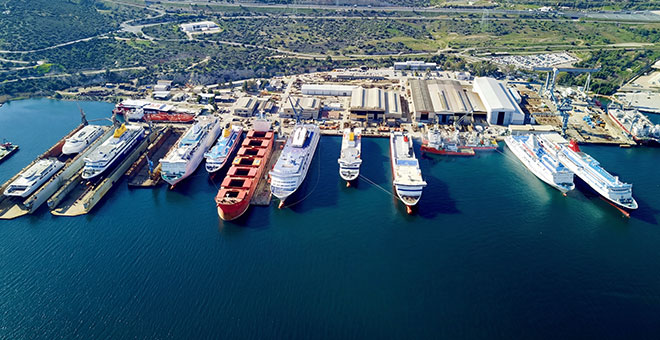
Mr. Xenokostas emphasized that ONEX shipyards have completed nearly 800 ship repairs in the last seven years — a record number in the history of the industry — employing directly and indirectly over 2,000 workers.
"We have won the bet of competitiveness," Mr. Xenokostas stated characteristically. Xenokostas. "We have proven that we can cope, and of course with the decisive support of Greek shipowners, to whom we are grateful." From shipyards inactive for 20 years with unpaid workers and debts of half a billion, we created units that successfully compete with shipyards in the Middle East and Europe. The strengthening of competitiveness and the restoration of the shipping community's trust are fundamental results of the first phase. Greek shipyards now operate with international standards, competitive costs, and reliable delivery specifications," he stated.
The second phase: From shipyards to energy hub
Mr. Xenokostas analyzed the development plan of the Syros and Elefsina shipyards into a "modern infrastructure supporting energy security, integrated logistics, and defense," with an emphasis on:
Support for LNG and LNG Carriers
Infrastructure and services for offshore/nearshore energy projects
Construction of infrastructure for offshore wind farms in the Aegean Sea
Technologies for new forms of propulsion
Integrated logistics for the Balkans and Eastern Europe
Mr. Xenokostas pointed out that the President of the United States himself, the largest economy in the world, has placed the revival of the domestic shipbuilding industry at the forefront. He referred to the importance of having a dedicated office in the White House for shipbuilding policy, emphasizing: "This demonstrates the strategic significance of the sector, not only for shipbuilding but also for supporting infrastructure related to energy security, energy transformation, and supply chain security."
The defense bet: 15% cheaper, 20% faster
Welcoming the statement of the Minister of National Defense Mr. Nikos Dendias that "the next ships will be built in Greek shipyards," Mr. Xenokostas emphasized:
"We have solutions that can bring the Navy years ahead compared to neighboring countries." We can deliver any complete ship platform 10–15% cheaper and 10–20% faster compared to any European option. We are not asking for favors; we are asking for equal treatment and trust from the Navy. For us, the defense industry is not a matter of sustainability — we already have customers. "We must build ships of Greek design and construction."
In closing his statement, Panos Xenokostas emphasized that the steady development of the Greek shipbuilding industry requires continuous cooperation between the state, shipping, and strategic international partners.
"The framework exists, the human capital is here, and the market recognizes the value of Greek shipbuilding." The next stage requires focus, consistency, and synergies at both national and international levels," he emphasized.

