






At a time when sea lanes, energy corridors, and undersea cables have been transformed from links in the supply chain into tools of geopolitical pressure, shipyards are emerging as the critical element of national sovereignty that ensures countries’ security and self-sufficiency in supply.
This message was emphasized by Panos Xenokostas, Chairman and CEO of the ONEX Shipyards & Technologies Group and President of the Hellenic Shipbuilders’ Association (HSA), during his participation yesterday in a fireside chat with the Director of naftemporiki.gr, Michalis Psilos, at the 10th Shipping Conference of Naftemporiki.
“National security cannot be bought or imported. It must be built in our country,” he noted emphatically. The transformation of the ONEX Group fits into this context; it is no longer limited to shipbuilding but is developing into a comprehensive industrial group that provides solutions for infrastructure and multimodal transport, as well as for defense, commercial, and energy projects.
From a Greece of defeatism to a Greece of “how can we make it happen”
Starting from the recent past, Mr. Xenokostas highlighted the transformation that has taken place in the sector: “For thirty years, the skeptics had convinced us that we couldn’t have shipyards. “We must move beyond a Greece of defeatism, of ‘it can’t be done,’ of ‘no,’ and of ‘let it go under,’ to a Greece of ‘how can we make it happen?’” he emphasized. The Group’s shipyards in Syros and Elefsina have completed over 900 ship repairs, with Greek shipowners accounting for approximately 80% of the business—a fact that, as he acknowledged, is due to the employees who “made it happen,” to the shipowners who “embraced our shipyards as their home,” and to the government’s steadfast support. The same logic, however, must guide the way forward: “We must want Greek shipowners here because we are competitive and better, not because they owe us a favor.”
Transatlantic axis: DFC, Hanwha, and Greece as a West-Asia hub
Referring to the strategic agreement in Washington with Hanwha Ocean and Hanwha Power Systems, as well as the long-term cooperation with the U.S. Development Finance Corporation (DFC), Mr. Xenokostas described ONEX as “an industrial hub where the interests of the West, American technological superiority, and American financing solutions with Korea’s technological and shipbuilding prowess—and all of this takes place in our country.” The agreement with Hanwha, he explained, “gives Greece a 30-year head start” and allows the Group to build surface ships and submarines—manned and unmanned, using American technology—covering the Mediterranean, the Black Sea, and Southeast Europe.
When asked about the possibility of building a Greek submarine, he replied frankly: “If we were to reach an agreement with the Navy today, we could deliver the first submarines in 8 to 10 years.” And he added, referring to the domestic industry’s participation in defense programs: “National sovereignty is neither about percentages nor quotas. It is 100%. The only difference from the past is that now we can.”
Europe: “Shipyards are part of shipping”
In a message to European institutions, the President of the Hellenic Shipbuilders’ Association (EEN) directly criticized the distortions in European industrial policy. “Europe has not understood that shipyards are part of shipping,” he said, calling on European institutions to realize that “the shipbuilding industry is both commercial and energy-related.” He highlighted the trends toward consolidation in the European defense shipbuilding sector, noting that “monopolies are always detrimental to overall development” and that two or three players cannot seek to dominate everything at the expense of the rest of Europe, while the commercial sector remains “idle.” “Greece is the southern pillar of Europe. Our geographical position is disproportionate to our energy and geopolitical significance,” he emphasized, calling on Europe to treat our country as a producer and exporter and not merely as a consumer and buyer.
Elefsina as a shipbuilding, port, and industrial ecosystem
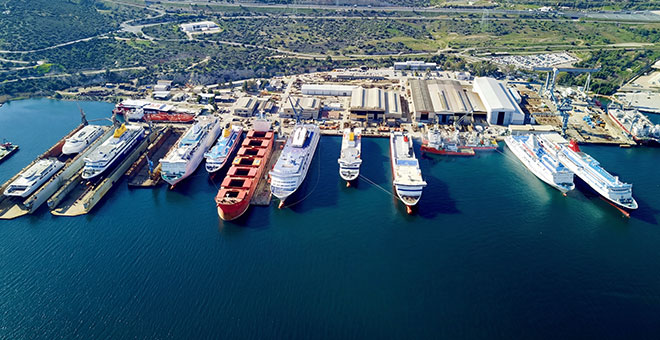
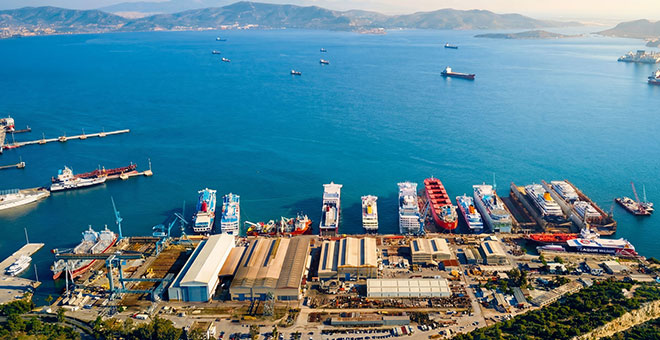
In Elefsina, the Group is developing new port infrastructure within the shipyard, expanding the total area of the facilities, while simultaneously signing an exclusive cooperation agreement with the AKTOR Group with the aim of jointly participating in the upcoming tender for the concession of the commercial operation of the Port of Elefsina, opening a second phase of development for the wider region. Combined with direct access to the National Highway and the rail connection expected to reach Elefsina within months, this creates a comprehensive integrated transport ecosystem. “The sea has no borders; the sea has no tolls,” noted Mr. Xenokostas, challenging the entrenched notion that Attica can be served by a single large port.
Tugboat Construction: ONEX as Builder and Shipowner
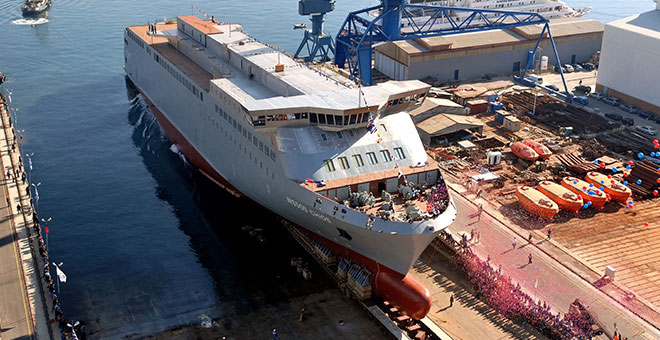
Regarding the construction of tugboats, Mr. Xenokostas confirmed that the production line for 20 tugboats (plus 20 on option) being built at the Elefsina shipyards is proceeding as planned. As he explained, the Group has chosen to invest its own funds through ONEX Shipping to ensure the continuous operation of the production line without competing with market operators. Some of the tugboats have already found buyers, with MEGATUGS among the first customers for the series, as the first two vessels are being built for the company, with the keel laid in April. Thus, new tugboat technologies are being adopted by the market more quickly. “We have no other choice but to pass on to our children what the previous generation failed to deliver: Greek-owned shipyards and ports,” he concluded.


