






The Greek shipbuilding industry is ready to bear the burden of renewing the coastal fleet, provided that there is corresponding institutional and financial support at the national and European levels. This was emphasized by the President and CEO of ONEX Shipyards & Technologies Group, Panos Xenokostas, speaking at The Economist's Maritime Conference held yesterday at the Divani Apollon Palace in Kavouri. Mr. Xenokostas spoke with Kostis Fragoulis, Founder & CEO of Franman and President of the International Propeller Club of Piraeus, and Alasdair Ross, Countries Editor of "The World Ahead 2026" of The Economist.
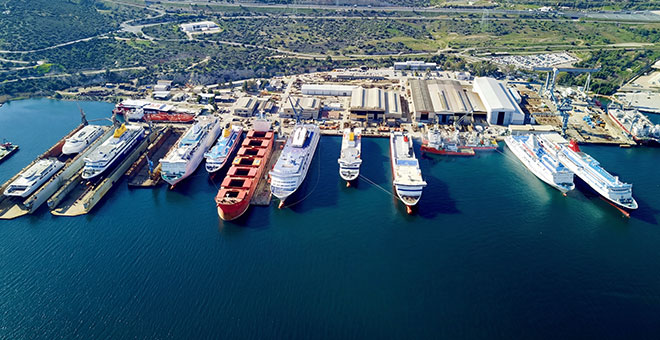
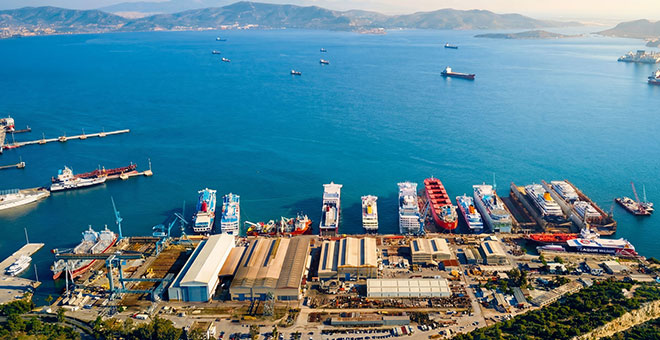
Panos Xenokostas, who is also the President of the Union of Greek Shipyards, emphasized that the modernization of the Greek coastal fleet should be a strategic priority, presented the recent strategic agreement with Hanwha Power Systems, and described the Group's vision for creating an integrated industrial hub in Elefsina.
Shipping: an issue of national cohesion, not just transportation
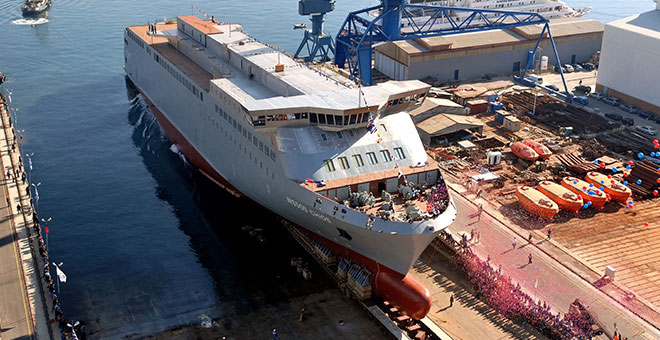
Asked whether Greek shipyards can meet the demands of modernizing the aging coastal fleet, Mr. Xenokostas gave a categorical answer: "I will give the obvious answer, that is, yes." We can build everything in Greek shipyards. This is now proven." He added, however, that before the shipbuilding aspect, the issue is "deeply political and primarily European."
Referring to insularity, connectivity, and sustainable societies, he emphasized that the modernization of coastal shipping is "essentially a social issue" and called for relevant legislation and funding resources from the Greek government and the European Union. As he said: "Once the political issue, the European one, of funding resources is resolved, the shipbuilding industry is here."
Placing shipyards and shipping in a context of direct interdependence, he notably remarked: "Shipyards and shipping are the backyard and the front yard of the same house." It is so unified," adding that this ecosystem must be treated "as the apple of the eye."
Economic footprint: 6,000 jobs, huge multiplier effect
To substantiate the ecosystem's dynamics, Mr. Xenokostas mentioned the ten-year collaboration with Attica Group, which includes maintenance, upgrades, scrubber installations, and major conversions, resulting in a dramatic increase in fleet availability.
Presenting the economic footprint of the sector, he noted: the euro that a passenger spends on a ferry fuels 3,000 jobs for Greek sailors in the ferry company, while thru repairs and upgrades, it creates another 3,000 jobs in the shipbuilding industry — money that stays in Greece. "The multiplier effect is enormous," he noted, reminding that the sector has a very significant impact on the country's GDP.
Redefining the role of the modern shipyard, he emphasized: "We don't sell hours or iron." "We sell results." He described ONEX as a "cloud" of integrated services for the shipowner, with solutions, technology, price transparency, and strategic security, in stark contrast to the traditional shipyard model.
Agreement with Hanwha: the next step in new shipbuilding
On the occasion of the agreement signed last week in Washington with Hanwha Power Systems, at an event at the U.S. Department of Transportation, Mr. Xenokostas described the collaboration as "the next step in strategic planning": a company with proven capability in shipyard regeneration joins forces with "the technology giant from Korea" for the construction of LNG ships, ferries, tugs, and floating power generation units.
As he explained, with the partnership, the Group aims to bridge the 30-year technological gap and establish new building capabilities not only for Greece but for the entire Mediterranean, Southeastern Europe, and the Black Sea. At the same time, the agreement aligns with the U.S. Maritime Action Plan of President Trump for the revival of the American shipbuilding industry.
Mr. Xenokostas reminded that DFC's participation in the financing scheme of Elefsis was the first investment of the American Development Finance Corporation in a shipyard worldwide, while the production line of 20+20 tugboats worth €200 million is already underway, with the Group taking on the business risk, committing to operate them as a shipping company if no buyers are found.
Call to Europe: "We need to move faster"
Emphasizing the strategic nature of the shipbuilding industry, Mr. Xenokostas mentioned the example of the USA, where President Trump declared the shipbuilding strategy thru the Maritime Action Plan: "This should serve as a model for many in any other country."


