






Panos Xenokostas, President & CEO of the ONEX Shipyards & Technologies Group and President of the Union of Greek Shipowners, left a strong impression with his statement today at the P-TEC conference taking place at the Zappeion Hall. At the 6th Partnership for Transatlantic Energy Cooperation, 4 U.S. government ministers, 25 EU energy ministers, and over 300 representatives from major companies in Europe, the United States, and Australia are in attendance.
Panos Xenokostas participated in the panel "Industry perspectives - Turning vision into action" and presented the vision and path of the ONEX Group toward the creation of an integrated shipbuilding and energy ecosystem, which repositions Greece on the international map of industrial production and energy security. As he notably remarked: "If someone had described to us in 2018 the current state of the Syros and Elefsina shipyards, we would have considered them crazy."
He referred to the starting point of the effort in 2018 and 2022, respectively for Syros and Elefsina, when the two units were in complete stagnation, with accumulated debts, degraded infrastructure, and a large number of employes who remained unpaid for several years.
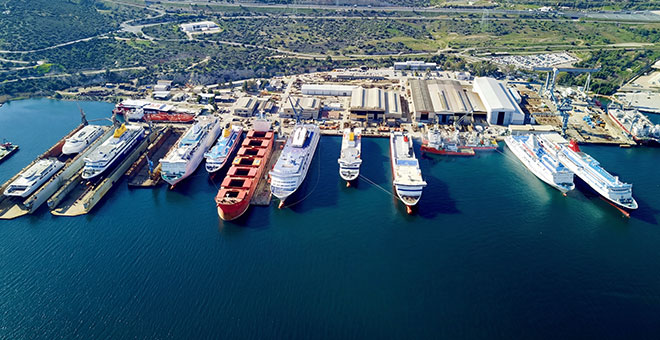
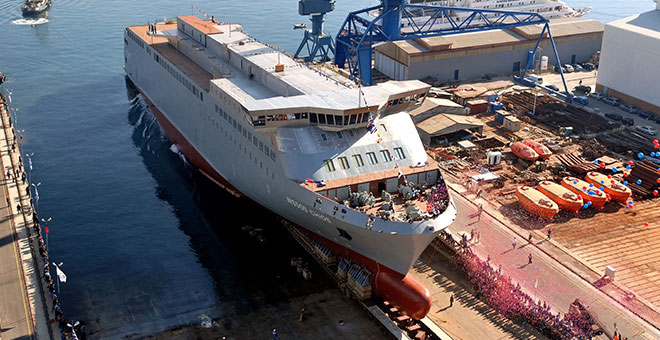
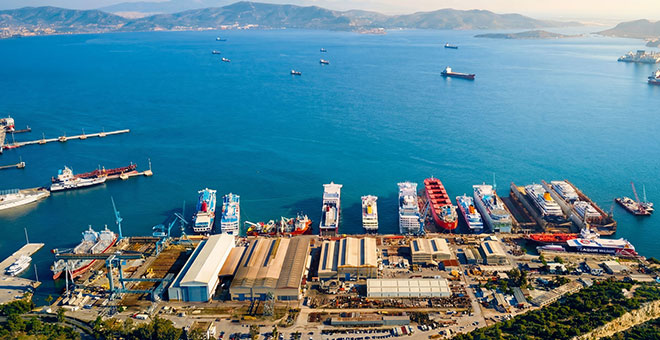
Today, the consolidation of the two shipyards under ONEX has formed the largest ship repair center in Greece, with more than 800 ships serviced within 2024, a performance recorded as the highest at the national level.
Mr. Xenokostas emphasized that the recovery path was based on the trust of the employes, the positive attitude of the local communities, and critical institutional interventions by the Greek government and the American side.
He particularly mentioned the legislative framework passed by the United States Congress, which allowed the financing of the first major investments of the ONEX Group by the DFC, making the Greek shipyards the first in the world to receive such support.
Regarding the Greek state, he mentioned the restructuring and recovery processes of Elefsina, which progressed with coordinated decisions by the government, making the smooth transition of the shipyards to sustainable operation feasible.
Panos Xenokostas presented the new phase of investments by the ONEX Group, which involves the transformation of Elefsina into an energy hub supporting LNG, with a complete vertical infrastructure of shipbuilding technology, logistics, and energy storage.
"Greece can serve as an alternative corridor for the transport of goods and energy from Attica to the Balkans and the Eastern Mediterranean," he noted, emphasizing that the related investments align with the European goal of energy autonomy and diversification of supply sources. He noted that the evolution of international competition in shipbuilding and the maritime industry is now taking shape on a global scale, with significant activity in markets such as China and India.
At the same time, he emphasized that ONEX shipyards now serve over 200 ships annually, including tankers, energy vessels, and LNG carriers, while investments in modern SMR and FNPP technologies are underway.
"These technologies will be the pillars of tomorrow's shipping and energy," he noted, emphasizing that "Greece's challenge is to move quickly, because now the power lies in knowledge, especially in the age of artificial intelligence."
In closing, the head of ONEX expressed his gratitude toward Greece's international allies: "Having the strongest allies by our side, we are not only grateful but also fully committed to succeed." At ONEX Group, we never stop until we succeed.
The presence of Panos Xenokostas at the 6th P-TEC confirmed the pivotal role of the ONEX Shipyards & Technologies Group in shaping the new energy and industrial ecosystem of Greece and the broader region, with a focus on innovation, sustainability, and the enhancement of Greek industrial production.